Illinois
Roofers in Illinois: what to know first
Roof leak, storm-hit roof or thinking about a new roof in Illinois? Here's what to check, the main roof risks in Illinois, and how to find a roofer who serves your area.
What you're probably wondering
Need a roofer? Call (888) 261-1486 to reach an independent local roofing company.
Start here
What's going on with your roof?
The roof problems Illinois homeowners search most. Tap yours for what to check and when to call.
Roof leaking right now?
Water dripping through the ceiling is stressful.
See what to check Book a visit this weekWater stain on the ceiling?
A brown ring on the ceiling can be a roof leak, a plumbing leak or condensation.
See what to check Get help todayShingles blown off in a storm?
Missing shingles leave the roof open to the next rain.
See what to check Book a visit this weekHail hit your roof?
Hail can bruise shingles and knock off granules without a leak showing for weeks.
See what to check Check first, plan aheadRepair or replace your roof?
A few problems can be repaired; widespread wear usually means replacement.
See what to check Check first, plan aheadRoofer knocked on your door after a storm?
Some door-to-door crews are fine; some are storm chasers.
See what to checkRoofing in Illinois
Spring hail and wind, then snow and ice dams in winter. Hail and severe thunderstorms in spring and summer, heavy snow and ice dams in winter. Asphalt shingles dominate, with metal growing in rural areas.
Main roof risks in Illinois
- Hail: Hail can bruise asphalt shingles, knock off the protective granules and dent vents and metal trim, often without a leak showing for weeks.
- High wind and tornadoes: Severe thunderstorms and tornado-season winds lift and tear shingles, most often along edges, ridges and corners.
- Heavy snow and ice dams: Heavy snow adds weight, and ice dams at the eaves push melt water back up under the shingles.
When roofs in Illinois take the most wear
- Hail: spring and early summer storm season
- High wind and tornadoes: spring storm season
- Heavy snow and ice dams: winter
What Illinois homeowners can check from the ground
- After a hailstorm, look from the ground for dented vents and metal trim, and for loose granules collecting where water runs off the roof.
- After high wind, walk around the house and look for missing or lifted shingles, bare patches and shingle pieces in the yard.
- In winter, watch for thick icicles and ridges of ice along the roof edge, and for new stains on top-floor ceilings and walls.
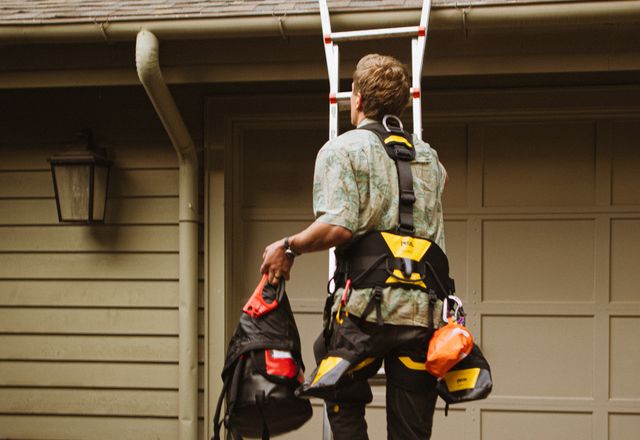
- Never climb onto a wet, icy or steep roof. A roofer can check it safely.
Calls come in from across Illinois, from Chicago and Aurora to smaller towns. Call and we'll check which roofing companies serve your ZIP code.
Roofing help we connect Illinois homeowners with
- Roof Repair: Shingles, flashing, vents, ridge caps and sagging sections.
- Roof Inspection: A roofer checks shingles, flashing, vents and the attic.
- Roof Leak Repair: Active leaks, ceiling stains and drips during rain.
- Emergency Roof Repair: Roof opened up, water pouring in, storm-hit roofs.
- Emergency Roof Tarping: Temporary tarp to stop water until the repair.
- Storm Roof Repair: Wind-lifted shingles, torn flashing, debris impact.
- Hail Roof Repair: Bruised and cracked shingles, dented metal.
- Roof Replacement: Full tear-off and replacement of worn roofs.
- New Roofs & Re-Roofs: New roof installation and re-roofing.
Areas served in Illinois
Homeowners across Illinois call us, including in and around Chicago, Aurora, Naperville, Joliet and Rockford. Call and we'll check availability for your ZIP code.
Before you hire a roofer in Illinois
- Ask how long they've worked in Illinois and for local references.
- Confirm they hold the credentials and coverage Illinois requires for roofing work.
- Get the scope of work in writing before work starts.
- After big storms, be cautious with door-to-door crews.
Our partner
Rather book online?
Compare local roofers, see their reviews and past jobs, and book online through Thumbtack. If the roof is leaking now, calling is quickest.
Rather not call?
Get roofing quotes online in 30 seconds
Tap your roof type and add your ZIP. Local roofing companies that serve your area will reach out.
- 3 quick taps, no long forms
- Local roofing companies near you
- No obligation to hire anyone
Questions
Do you have roofers in Illinois?
Yes. Our network connects homeowners across Illinois with independent roofing companies. Availability can vary by ZIP code and type of work.
How fast can a roofer come out in Illinois?
It depends on your location, the season and recent weather. After major storms roofers book up quickly, so call early.
Does hail hurt roofs in Illinois?
It can. Hail is one of the main roof risks in Illinois. Bruised shingles are hard to spot from the ground, so after a big storm many homeowners have a roofer look up close before small problems turn into leaks.
What wind blows shingles off a roof?
Older or poorly sealed shingles can lift in gusts around 50 to 60 mph, while newer wind-resistant shingles hold on in much stronger gusts. Shingle pieces in the yard after a storm are the sign to get the roof checked.
Why does my roof leak when the snow melts?
Usually an ice dam: heat from the house melts snow higher up, the water refreezes at the cold roof edge, and the trapped water backs up under the shingles. Attic insulation and ventilation, plus an ice barrier at the eaves, are the long-term fixes a roofer will look at.